
The Jump Gate series now offers five volumes that record the history, the trials, the successes, and the failures of a technology that evolves from a quirky time machine to a space battleship-sized Jump Gate over five volumes.

Larry Wasion is a science-fiction author fascinated by the moral weight of innovation and the human cost of progress. His work explores leading-edge technology, ethical choice, and family legacy across generations. Through stories where invention reshapes destiny, he examines how brilliance, ambition, and responsibility collide. His five-volume traces the evolution of a singular breakthrough from improbable experiment to universe-altering power.

Lorem ipsum dolor sit amet, consectetur adipiscing elit. Integer nec odio. Praesent libero. Sed cursus ante dapibus diam. Sed nisi. Nulla quis sem at nibh elementum imperdiet. Duis sagittis ipsum. Praesent mauris. Fusce nec tellus sed augue semper porta. Mauris massa. Vestibulum lacinia arcu eget nulla. Class aptent taciti sociosqu ad litora torquent per conubia nostra, per inceptos himenaeos. Curabitur sodales ligula in libero. Sed dignissim lacinia nunc.
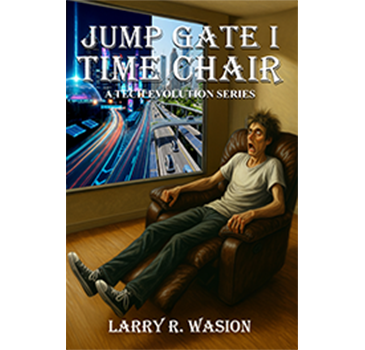
Time was never meant to be touched only measured. What begins as an eccentric experiment, a machine built more from curiosity than caution, becomes the spark that reshapes generations. Jump Gate I: Time Chaser introduces a world where cutting-edge technology collides with human ambition, and every breakthrough carries consequences far beyond its creators.
In TIME CHAIR, the time machine is more of a thought experiment passed from hand to hand, each owner revealing new dimensions of its potential and peril. With strict limitations of only 90 days backward, no altering known history, and relocation based on the chair’s physical whereabouts, the machine becomes a mirror reflecting human ingenuity, desperation, and moral ambiguity. A petty crook exploits loopholes for profit, a private investigator wrestles with billing paradoxes, and a courier finds elegant solutions to logistical nightmares. These vignettes form a mosaic of ethical and practical dilemmas, culminating in the birth of a new organization manufacturing devices for the FBI.
Rejecting genre clichés, TIME CHAIR reimagines the mad scientist not as a villainous genius but as a bitter, alienated man whose rage fuels innovation and whose loss of the machine sets the entire saga in motion. Time travel here is not a playground for rewriting history, but a crucible for character development. Some travelers don’t bounce back and forth; they commit, age forward, and live with their choices. The machine doesn’t just move through time it relocates its load to wherever the machine was on the chosen day. With morphing motorcycles, time-traveling drones, and threats ranging from cougars to covert investigations, the story blends speculative science with grounded drama. It’s not about changing the past it’s about surviving it, shaping the present, and preparing for a future that can’t be skipped.
As the story prepares to transition into the second volume, the narrative shifts from episodic exploration to a more linear, long-form evolution. A single family, already embedded in the tale, becomes the anchor for the future of the tale’s arc. Their company inherits the technology and, under government oversight, over 150 years, evolves the tech into the Jump Gate a teleporter that doesn’t traverse time, but relocates users instantly to the selected machine’s location. This subtle but profound shift reframes the device from a temporal novelty to a logistical revolution. The family’s journey parallels the tech’s maturation, as they navigate ethical quandaries, bureaucratic entanglements, and personal transformations. Their story is not just about invention, but about legacy, responsibility, and the human cost of wielding power that bends the rules of reality.
Lem Parker, a former Navy strategist, expects a routine job at Timely-Drones, until he uncovers a massive shipping backlog and solves it effortlessly, revealing his extraordinary talent. Drawn into the company’s hidden depths alongside Kimberly Solomon, Lem discovers a relic far older and more advanced than anything they’ve seen: the original time-deck, a device that isn’t just a time machine, it’s a teleporter.
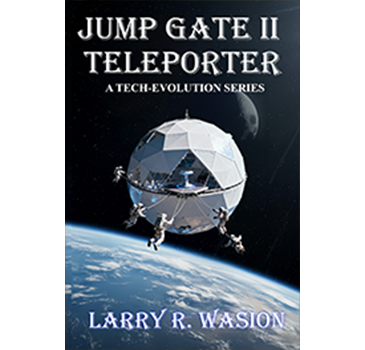
In TELEPORTER, the second volume of the saga, a modest manufacturing startup born from the eccentric invention known as the Time Chair evolves into a global powerhouse. What began as a quirky experiment in localized displacement becomes the foundation for a revolutionary teleportation system with a staggering 1.5 light-years range. The family behind the company, whose journey began in Jump Gate I, drives the innovation forward across generations, navigating the treacherous waters of government secrecy, corporate espionage, and personal loss. A kidnapping turns the stakes from technological to emotional, anchoring the story in human resilience.
Teleportation technology reshapes society in profound ways. In medicine, organs are transplanted minutes after removal, teleporting across continents. Emergency care becomes instantaneous, with patients delivered to specialized clinics worldwide. In space travel, teleportation bypasses the brutal 5-G liftoff and fiery reentry, allowing safer access to orbit and lunar platforms. It redefines not just where we work, but how we work enabling exploration of Sol’s outer planets with unprecedented efficiency. Yet space remains dangerous, and teleportation only shifts the risks, not erases them.
Military strategy is transformed. Defensive positions are reinforced before attacks begin, and intelligence is gathered in real time. Soldiers can port out of tight spots, and commanders can deploy tailored responses based on instant enemy assessments. On Earth, surface travel becomes frictionless vacation homes in remote wildernesses are now weekend getaways, accessible only by teleporter. But with every leap forward comes tension. Who controls the portals? Who decides who gets to jump? The company’s rise is shadowed by ethical dilemmas and political resistance, as teleportation challenges the very structure of society. Teleporter is a story of innovation and upheaval, of a family’s legacy entwined with humanity’s future. It explores the cost of progress, the fragility of trust, and the bridges we build across space, across time, and across the human experience.
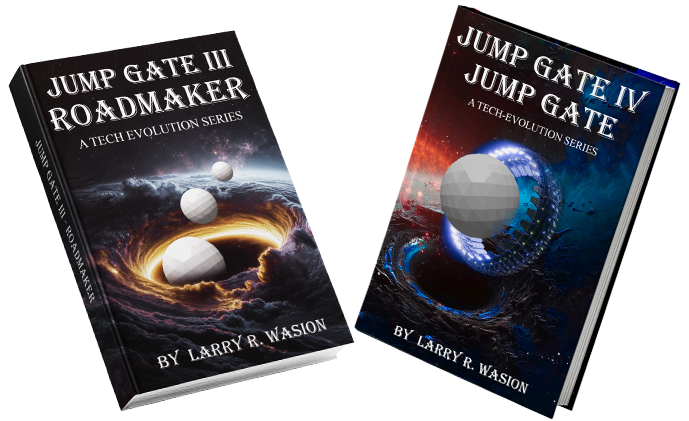
In Jump Gate III – RoadMaker, humanity pushes the boundaries of space and time. With teleportation technology now perfected, the cosmos is no longer out of reach, but exploration comes at a cost. Amid cosmic dangers, political intrigue, and technological marvels, pioneers navigate uncharted worlds, facing choices that could shape the fate of civilization. Adventure, suspense, and discovery collide in this thrilling continuation of the Jump Gate.
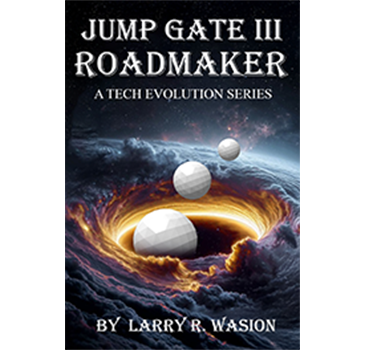
In ROADMAKER, the third volume of the story, humanity’s journey to the stars reveals a paradox: space travel is both mind-numbingly dull and terrifyingly fast-paced. The century-long voyage to a colony four and a half light-years away is punctuated by rare but explosive crises sabotage, political unrest, and religious resistance to emigration. When danger strikes at relativistic speeds, solutions must be immediate and precise. The story explores how humans adapt to this tension, developing teleportation technology not just for survival, but for expansion. This tech revolutionizes space travel, enabling continuous acceleration and the creation of a web of “Porters” instantaneous gateways that support immigration, crew rotation, and supply chains across vast distances.
Mining the Asteroid Belt becomes a central focus, with teleportation tech unlocking access to its scattered riches. Prospecting proves difficult: the Belt is vast, thin, and unpredictable. Valuable resources like gold, rare earth metals, gems, and water are hidden among widely spaced asteroids, demanding precision and patience. Ceres, the largest object in the Belt, becomes the hub of operations. Here, materials are processed in microgravity, offering both advantages like reduced wear on equipment and challenges, such as handling fine particulates. The Belt’s harsh realities contrast with the luxury that springs up around Ceres, which transforms into a destination for the wealthy and adventurous. Tourists flock to its low-gravity bars, panoramic restaurants, and guided asteroid excursions, turning a mining outpost into a cultural phenomenon.
Meanwhile, teleportation tech opens new frontiers on Mars. Crews explore ancient lava tubes, searching for signs of long-lost life and clues to the planet’s mysterious past. The ability to teleport directly into subterranean chambers bypasses traditional landing hazards and accelerates scientific discovery. Yet progress is not without resistance. Political factions and religious groups question the ethics of teleportation and the implications of rapid expansion. These tensions simmer beneath the surface, threatening to destabilize the fragile unity of Earth’s spacefaring nations. RoadMaker blends high-speed peril, economic ambition, and philosophical conflict into a sweeping narrative of human ingenuity. It’s a story of building roads where none existed across space, across ideologies, and into the unknown.
In Jump Gate IV, humanity faces its fiercest challenge yet as Earth and its pioneers are thrust into an interstellar conflict with ruthless alien forces. With the Jump Gate network expanding across the stars, war tests alliances, technology, and the very will to survive. Amid battles, betrayal, and unexpected discoveries, heroes must push beyond fear and redefine what it means to protect humanity in a universe that refuses to be tamed.
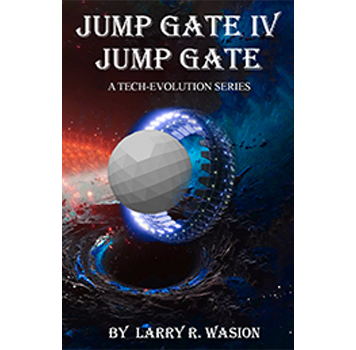
In JUMP GATE, the fourth volume of this tale, humanity’s bold leap to colonize Terra a planet orbiting the chaotic triple-star system of Alpha Centauri comes with brutal surprises. Terra’s crushing gravity, toxic soil, and hostile native species challenge settlers to invent radical solutions for survival. The colony’s isolation intensifies when Earth is attacked by an aggressive alien force wielding stolen space technology. Cut off and vulnerable, the settlers must adapt quickly, repurposing Earth’s teleporter tech to develop the Jump Gate a massive device capable of transporting entire warships across light-years. But placing a receiver near enemy territory demands stealth and ingenuity, forcing the colonists to confront not only alien threats but the limits of their own technology and resolve.
The story unfolds across a richly imagined galactic tapestry populated by alien civilizations with wildly divergent evolutionary paths. The Grey Gants, primitive telepaths incapable of sound, were seeded on a foreign world for sinister reasons. Their successors, the Red Gants, rule space but lack understanding of the tech they stole. Meanwhile, the Munchies once technologically advanced are trapped on their planet by orbital weapons installed during a slave revolt. These species wield magnetic levitation, launch slugs via mag-lev slings, and live underground in oxygen-poor atmospheres where explosives only fizz. Their aging fleets and fractured societies contrast sharply with Earth’s armada: sleek battleships, nimble Mosquito fighters, cruisers, and teleportation-enabled jump gates. The clash of cultures and technologies sets the stage for a war that spans planets, orbits, and ideologies.
As the conflict escalates, warfare erupts from Terra’s surface into orbit and to another star system, culminating in a chaotic battle around an ancient alien space station. Earth’s forces, though technologically superior, must contend with the unpredictable tactics of alien fighters and the limitations imposed by unfamiliar environments. The Jump Gate becomes both a strategic weapon and a symbol of human ingenuity, enabling surprise assaults and rapid reinforcements. But victory hinges not just on firepower it requires understanding the alien psyche, exploiting the weaknesses of fractured empires, and navigating the drifting gravitational zones of a three-star system. Jump Gate is the most science-fiction-rich installment yet, blending cosmic warfare, philosophical intrigue, and technological marvels into a finale that challenges the boundaries of space, time, and survival.
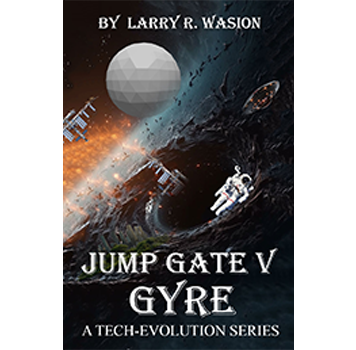
In Jump Gate V: Gyre, the boundaries of human exploration stretch even farther into the cosmic unknown. As the Jump Gate network evolves, powerful forces, both human and alien clash across star systems, testing loyalty, courage, and hope. Amid high-stakes missions and swirling political tension, pioneers must navigate treacherous gyres of space and ambition. This thrilling chapter in the Tech-Evolution series pushes survival, discovery, and the future of humanity to its brink.
GYRE, dives headlong into the cosmic refuse of history: the Great Milky Way Garbage Patch. This swirling gyre of ancient detritus satellites, probes, derelict ships, and forgotten civilizations becomes an archaeologist’s dream and a scavenger’s paradise. It’s a place where the past isn’t just remembered, it’s mined, stolen, and sometimes weaponized.
Set after the retreat and defeat of Earth’s invaders in Jump Gate IV, our heroes now find themselves on the edge of a kingdom ruled by an ancient species. The Gyre is part of this realm a gravitational and political vortex where ancient tech, some more advanced than anything modern science can fathom, lies waiting to be discovered. But treasure hunting in the Gyre is no simple task. Alien governments, ruthless pirates, enigmatic Patch-Cops, and the patch-dwellers themselves some friendly, many not complicate every move.
Inspired by the real-world Great Pacific Garbage Patch, the Gyre is a metaphor made literal: a slow-moving current of cosmic debris, shaped by the forces of time, gravity, and forgotten ambition. Once something drifts into its grip, escape is rare. And what lies within? The wreckage of civilizations that rose and fell over 13.6 billion years. Faster-than-light freighters stalled mid-journey. Alien astronauts mummified in the cold vacuum of space. Fragments of cities shattered by their stars going supernova. Even creatures that feed not on oxygen, but on cosmic radiation, haunt the darkest corners of the patch.
The Gyre is more than a setting; it’s a crucible. A place where the team must navigate diplomacy, danger, and discovery. Where the line between archaeology and piracy blurs. Where the ghosts of the galaxy whisper through broken hulls and ancient data cores. And where survival demands not just firepower, but empathy, ingenuity, and the courage to face the unknown.
Jump Gate V–Gyre is a love letter to cosmic history, to the detritus of progress, and to the characters I refuse to forget. It’s a story of what we leave behind and what we might find if we dare to look.
Larry Wasion is an author to watch. This book is a real page-turner, and I hope Mr. Wasion releases more like it soon!
“An original take on time travel and teleportation. Until reading TELEPORTER I didn’t realize the two technologies could be so intimately linked. Excellent book. I am sure the rest of the series will be as sweet.”
I grew up in the house of a major science fiction fan (My father). He had always been an avid reader, and just a walk through the house would show that. There were books everywhere. Unfortunately, I never caught the reading bug as he did. Since I always looked up to my Dad.
I always wished I had. But my brain rarely works like that. I read The Hobbit in high school, and the Lord of the Rings trilogy after the first movie came out. That’s pretty much been my library of novels I finished. All that being said, I am also a huge science fiction nerd, and I LOVE time travel stories, which is what initially caught my eye about this series. So, I had a few extra dollars after selling a vehicle and figured, heck, why not, and bought the series, hoping it drew me in enough to read them through.
Well, I recently finished the first book and am halfway through the second now, and have to say I’m hooked. The story is fun, the characters are great, and all of the time-travel science seems plausible. With a concept like time travel, the science has to be good to be believable, as opposed to fantasy, where magic is involved, which, while I love it, always seemed like a convenient thing whenever something unexplainable was happening, so it’s kind of a copout. Anyhow, I’m rambling. Ultimately, this series so far is fun with fun characters and good science. Keep up the good work, Mr. Wasion.
Time machines seem to have only a few possible structures: a chair with a clock behind it, a fancy bunch of clocks on their own, a DeLorean car, or a miniature rocket ship. Larry Wasion has outdone them all with a time machine that’s a chair, all right a beat-up double-wide recliner, patched up with old leather grabbed from a dumpster. This one doesn’t even have a clock, although it does have a hidden control panel.
What’s most intriguing about Wasion’s time chair is that it lands in the clutches of one owner after another, few having sufficient knowledge of what they’ve accidentally acquired. They’re a motley bunch, including a mad scientist (“mad” as in enraged), a boneheaded thief, a heroic but down-on-his-luck private eye, as well as smart women and others who learn or already know what the chair can do, but don’t plan to tell anyone else. Each turn of ownership results in disaster or near-disaster, driving the story to higher anticipation.
Every one of these characters (and there are many more in this book) is unique, fascinating, and remarkably believable. One of the author’s great strengths is his ability to conjure up unusual but deeply persuasive characters. Part of that ability must come from his own high-tech experience in a career that depended on advanced work in outer space, the depths of the oceans, and the South Pole.
Wasion was a science fiction fan for years, but this is his first novel. His spectacular scenes with fascinating characters and his almost persuasive technical explanations, as unreal as they may be in fact, make this work extraordinary for a first timer. Is it perfect? There are flaws — a ragged beginning, a too-complicated conclusion — but the nucleus of this fast-paced story is far better than average. That, and the promise of what’s going to come, make Larry Wasion’s first shot at science fiction a five-star victory.
(Paul is co-author or Arthue C. Clarkes, Venus Prime.)

I received Larry’s series of books for Christmas (purchased by loved ones on Amazon). I must confess – I am his second-youngest brother – so I know a thing or two about the author’s background and childhood. And I can clearly see how the influences in his life as he grew into adulthood have affected his imagination as much as his vocational experiences. I can read the influences from his love of science fiction, as well as his love of comic books
(the morphing motorcycle reads like it came out of a Marvel superhero comic), with a little of his love of secret agents sprinkled in here and there. As for the book itself – riveting. I found myself invested in the characters – all well thought out. I can almost hear Larry thinking, “What would this character do with this time machine? How would (s)he react in this particular situation?” What really impressed me is that, though the time chair is the central “character,” he seems to have treated it as more incidental to the lives of the characters – the characters are more central to the story than the chair. So, it’s more about how the chair impacts their lives than it is about the chair itself. I really like that!
I’m not nearly as much of a reader as Larry was/is, but when I had to put the book down to resume my own life, I really wanted to know what would happen next.
And now I want to know what happens next – so on to the next book…
Just finished book four – what an amazing story! I could hardly put it down! So imaginative and detailed and thrilling and engrossing. I loved it. I’m amazed how you came up with all this stuff. Is it from lying in bed at night or all the years of sci-fi that you read bubbling in your brain, creating new stories? In any case, I thought it was wonderful. The story just drew me in… what a great piece of writing. Best I’ve read, really up there with Heinlein, better than Azimov to me. U should be proud of your accomplishment, my friend. Can’t wait for book five